Agincourt
Henry VAgincourt is the battlefield at which King Henry V’s French campaign reaches its decisive military and theatrical turning point. The play identifies it first as the place of a French camp and then, when King Henry V asks the name of a nearby castle, as the field on which the battle is fought. Its significance rests both on that naming and on the gap between the battle’s scale and what the stage can represent: the Chorus acknowledges that a few ragged performers must stand for the name of Agincourt, while asking the audience to recognize the truth through its theatrical imitation.
Setting and Military Context
Agincourt enters the play within the geography of an ongoing French campaign. Earlier, the Archbishop of Canterbury urges King Henry V to divide England into four and take a quarter of its resources into France, presenting the expedition as a concentrated use of the kingdom’s strength. The battle site is therefore not an isolated setting: it belongs to a campaign whose ambitions are expressed in terms of mobilizing England across the Channel.
The action before Agincourt includes the siege of Harfleur, where the Archbishop directs attention to siege guns on their carriages and their threat to the town. In a later exchange about the mines, Captain Fluellen objects that the mining practice is not according to the disciplines of war. Harfleur and its siege works are distinct from Agincourt, but these references establish the campaign as one conducted through particular military operations and disputes about their conduct, rather than as a single unbroken battle scene.
The Camp and the Battlefield
The play locates a French camp near Agincourt before the battle. Montjoy, speaking as the French king’s messenger, carries a warning to King Henry V that advantage can serve as a better soldier than rashness. The warning frames the approach to the battle as a contest of judgment as well as force. King Henry V, for his part, acknowledges that sickness has weakened his people and that his numbers have fallen, leaving the men he has with him almost no better than the French in condition. The proximity of the French camp and the battlefield makes these reports part of the immediate setting of the encounter, while the opposing accounts stress calculation, depleted strength, and risk.
After the fighting, King Henry V asks what the nearby castle is called. Montjoy answers that it is Agincourt; King Henry V then names the field Agincourt and associates the fight with the day of Crispin Crispianus. The exchange gives the location its explicit identity within the drama: the castle supplies the name, and the king’s declaration attaches that name to the battlefield. It also marks a shift from battle as an immediate action to battle as a place and event that can be named and remembered.
From Campaign to Battle on Stage
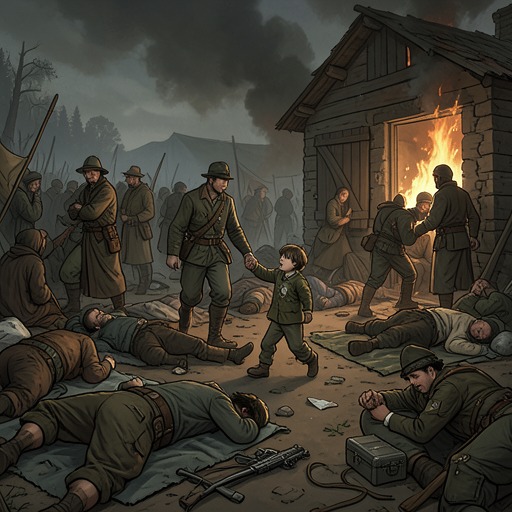
The Chorus makes the transition to Agincourt explicit by announcing that the scene must fly to the battle. At the same time, it warns that the representation will use only four or five ragged performers and may disgrace the name of Agincourt through a ridiculous brawl. The limitation is not presented as a literal description of the historical battle or its forces; it is a statement about the theatrical means available to evoke it. The audience is asked to attend to the event through the difference between the inadequate stage imitation and the battle it signifies.
That contrast shapes the location’s dramatic force. Agincourt is both the named field of the fighting and a test of theatrical imagination: the Chorus admits that the stage cannot reproduce the encounter’s full scale, yet insists that an imperfect enactment can still point toward it. The battle’s place in the play thus depends not only on what happens there, but on the audience’s recognition that a small, visibly limited performance stands in for an event whose name carries far greater weight.